Benjamin6 (Joseph5, Benjamin4, Gamaliel3, John2, Roger1)
and Electa (Cook) Terrell
Nancy Tyrrel Theodore, February 2011
Benjamin6 was born 14 February 1793 at Watertown, Litchfield, CT to Joseph5 and Chloe Terrill. We have E. H. Young to thank for this and other information on Benjamin, contained in his A History of Round Prairie and Plymouth 1831 - 1875 a, an area located near the adjacent borders of Hancock and Schuyler counties in Illinois. Benjamin married Electa Cook on 21 September 1815 in Connecticut.
Benjamin "was a machinist, but spent most of his life, at the east, in making clocks. Eli Terry was one of the first, if not the first, to establish the manufacture of wooden clocks in this country on an extensive scale. His first venture was in making three of the tall clocks that would reach from floor to ceiling, the works of which he whittled out with a jack-knife. These clocks were sold at forty dollars each. Making clocks with a jack-knife, as in Germany, was too slow a process for Yankee enterprise, and Mr. Terry called to his assistance the mechanical skill of Benjamin Terrell to aid him in making machinery to supplant the jack-knife in doing his work.
"In making such machinery, and in the manufacture of clocks, Mr. Terrell worked for a number of years for Mr. Terry, and also for Seth Thomas, whose establishment at Plymouth Hollow was started not far from the same time with Mr. Terry's at Terryville. Mrs. Terrell also worked at the clock business in her younger days, her work being the painting of the figures and ornamental work upon the dials. Her acquaintance with Mr. Terrell was formed while both were working in the clock factory." a
Terryville and Plymouth are located quite close to one another in Litchfield county, Connecticut. On an atlas they appear to be about a mile apart, while Watertown sits about six miles to the south. Six miles being a far commute in those days, it is easy to understand why Benjamin established himself in Plymouth. He shows up there on the 1820 census, when he was about 27 years of age. The census records: Benjamin Tyrrell, 1 male under 10, 1 male 26-45, 1 female under 10, 1 female 16 to 26, and one person "engaged in Manufactures," .... that would be Benjamin, the machinist and clock maker.
In 1830, Benjamin6, still in Plymouth, Connecticut, is shown on the census: Ben Tyrrell, 1 male 15 to 20, 1 male 20 to 30, 1 female 5 to 10, 1 female 10 to 15 and 1 female 30 to 40. So, at this time his family consisted of a wife, Electa, and three children, Charles Cook7 Terrell being the only son and eldest child... the "1 male 15 to 20" being Charles who was born 13 October 1816 b and age 15 at the time of the census.
The 1840 census finds Benjamin, with the appearance of a greatly increased family, outside of Quincy, Adams county, Illinois: Benjamin Terrill, 3 males 15-20, 1 male 40-50, 1 female under 5, 2 females 15-20 and one female 40-50. Son Charles isn't on this census as he would have been 26. But this increase of males in the household can be accounted for, they are living with Benjamin and Electa while attending the Mission Institute in which Benjamin had involved himself. Young explains how this cross-country move and other changes came about. "During the summer of 1835, the government land sales occurred, resulting in many changes and in considerable additions to the population of the neighborhood [Round Prairie and Plymouth, IL]. A number of those who came earlier, and occupied their premises by pre-emption were without means to pay the amount demanded by the government for their lands, and were glad to sell their 'claims' and 'improvements,' and obtain in this way the means to 'enter' a new lot upon which to build up a new home..... Mr. Terrell located with his family on Round Prairie in 1835, buying out the claim of Matthew Melton, adjoining that of Mr. Cook on the west.
"Here he made the attempt to become a farmer, but Mrs. Terrell says, 'he found that a clock maker was not the best material of which to make a farmer.' In 1839 he moved to the vicinity of Quincy, to aid in the establishment of the Mission Institute and to give his children the benefit of an education in it. He remained [t]here until this enterprise was abandoned on account of the death of its principal founders, Drs. Nelson and Hunter. Mr. Terrell worked for some time afterwards at his business as machinist in Quincy. After the building of the railroad, he again located in Plymouth." a
So, on the 1850 census, Benjamin was still in Adams county, Illinois, in Melrose township. This is the first census listing members of the household. In household 20/21: Benjamin Terrell, 57, Machinist, born Conn.; Electa, 58, born Conn. In household 20/23 John Reynard 33, M.[P?] Minister, England; Mary M. 26, Conn; John 1, Ohio; Elizabeth Terrell 15, Ill; Eliza Miller, 2, Ill; Dorothy Ogden 28, Canada. In household 20/22: Charles [F.?] Terrell, 36, Physician, born Conn.; Hannah, 28, born Ill; Amelia A., 9, born Ill; George T., 6, born Ill; Benjamin M. 2, born West Indies. West Indies!!..... how did this come about?
Grandfather Joseph4 Terrill supported the Episcopal church in Watertown, Connecticut, h and his religious zeal carried down to his son and family. Young says of Benjamin's religious affiliations, that "while Mr. Terrell lived at the east, his church relations were with the Episcopal Church, but after his removal to Round Prairie, he with his family, and also Mr. Cook and family, were among the original and active members of the Congregational Church." Upon their arrival in 1835, "the New England families were scarcely settled in their new locations until they began to cast about for the establishment of religious services of their own preference, and in October, Rev. William Kirby, of Mendon, commenced an engagement to supply them with preaching once a month for one year. For three months these services were held, sometimes at the house of Mr. Burton, and sometimes at the house of Mr. Terrell, who had bought out and now occupied the Melton claim, south of Plymouth."
They then transferred their worship to a large cabin belonging "to Capt. Norman Hart, and organized the Congregational Church of Round Prairie on 6 January 1836." Among the founding members Mr. Benjamin Terrell and his wife, Electa, with their daughters Maria and Mary M.....; Mr. Lamarcus A. Cook and his wife Marietta - received by letter..... Mrs. Rev. George Thompson (Martha Cook) was with her husband for several years in the same field - was driven from it by ill health, and is now in a Home Missionary field in northern Michigan... Charles Terrell, M.D., West Geneva Michigan... Mrs. Mary M. Reynard (Terrell) has recently returned to Plymouth with her husband, Rev. John Reynard, deceased - a Presbyterian clergyman - were for many years residents of Shullsburg, Wis. After her husband's death she resided for a time with her family in Dixon, Illinois, and now [c. 1876] again has taken up her abode amid the scenes of her earlier western life."
This would seem like a complete recounting of the family and Benjamin's religious life and the adventures of Benjamin and Electa in their early years in Illinois. But there is much more. We still have to get Charles to the West Indies.
Young told us that Benjamin moved to the vicinity of Quincy in 1839 to help establish the Mission Institute, and there is a lot of history there. A Dr. David Nelson (1793-1844) founded the institute. During the War of 1812, Nelson was a surgeon, but he gave up the practice of medicine to become an evangelist and a Presbyterian minister. In 1831, Nelson became a founder of the Marion College in Palmyra, Marion county, Missouri, and the first president of the college and its minister. In 1836, he exhorted the slave owners in his congregation to free their slaves and "a mob forced his immediate departure from Missouri." c
He then took up residence across the river in Quincy, where he founded the short-lived college, the Mission Institute, "whose purpose was the education of Christian missionaries for Africa, the West Indies, and other locals." c So, that is how Charles ended up in the West Indies where his son, Benjamin8, was born, and a daughter, Electa8 who was born in the "Bahama Island.." and died before the 1850 census.
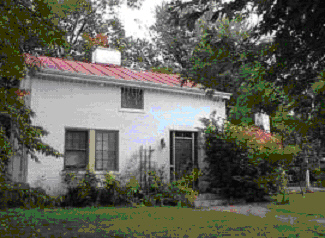
Nelson's Quincy students, and we must assume Charles was among them, would regularly cross the Mississippi to tap stones together as a signal for slaves to emerge, and then guide them back across river to a red barn "waiting room" 16 miles inland c. In the winter of 1843, a party of Marion county anti-abolitionists crossed the ice on the Missouri and burned the Mission Institute chapel d. But the home where Benjamin and Electa lived was spared and has been preserved by the City of Quincy, and is described thus:
|
|
"Benjamin and Electa Terrel House: 2531 Prentiss Avenue. This vernacular house, built in 1840, is one of the oldest brick structures in Quincy. The Terrel House first served as a four room dormitory for the students attending the Mission Institute, a Congregational training school for foreign missionaries founded in 1836 by abolitionist Dr. David Nelson. The central chimney dates from an 1860s remodeling, and the house was substantially altered again during the 1930s. Benjamin Terrel worked as a machinist, and served as a trustee and chairman of the Institute's Board of Trustees; his wife Electa was enrolled as an Institute student."
We now turn our attention to Electa and her Cook family. Again, we are indebted to Young. In 1836, the town of Plymouth in Illinois was staked out, the center being "section 36, township 4 N., 5W.... The proprietors of the town were John W. Crocket, James Clark, Benjamin Terrell and Lamarcus A. Cook. The two latter were from Plymouth, Connecticut, hence the name of our town. Clark and Crockett were from Kentucky - the latter a near relative of Colonel David Crockett, noted as a hero in the Texan war of independence." Section 36 was thus divided four ways with 12 ½ acres each:, John W. Crocket in the NE quarter, James Clark in the NW quarter, Benjamin Terrell in the SW quarter and Lamarcus A. Cook in the SE quarter. U. S. land grants for Benjamin of Hancock county, dated 10 October 1840 show he also obtained another 139 acres in Schuyler county, IL.
Young explains that "Lamarcus A. Cook was born in Plymouth, Connecticut, May 12th 1794, and was married to Maretta Adkins. Mr. Cook was raised a farmer, and has followed that business nearly all his life. There was an exception of three or four years while he lived at the east, during which he was engaged in selling clocks..... Mr. Cook was enrolled in a military company during the War of 1812-15, and held subject to duty, but was never called into actual service.
"In the spring of 1835, in company with Messrs. Adkins, Burton, Terrell, and others, Mr. Cook came to Illinois. They came via Philadelphia, Pittsburg, and St. Louis. Here the company separated, Mr. Cook and Mr. Adkins going up the Illinois River to Peoria and thence to Farmington, and the others by way of Quincy to Mendon. This division of the company was merely for convenience in obtaining temporary accommodations for their families, as they had decided to locate in the same neighborhood. After prospecting a portion of the summer they decided upon Round Prairie as their chosen home, and settled here in the fall of 1835. Mr. Cook still resides [c. 1876] at his chosen home of forty years ago. He is now in his eighty-second year, and is apparently vigorous enough to last until his centennial."
Lamarcus A.6 Cook, and Electa6 are the children of Arba5 Cook (Ebenezer4, Henry3-2-1). e The genealogy through Arba6 was published by Jacobus f in his Families of Ancient New Haven, and Atwater's History of the Town of Plymouth, Connecticut. g
By deed recorded 5 August 1822 [Plymouth 7:137 LDS #5405], Electa Cook of Plymouth, Litchfield, Connecticut sells to Truman Cook "all such right on the buildings distributed to me out of my honourd Father decead Estate" except "my right in my honord Mothers thirds which may fall to me out of my honourd Father Arba Cook decd Estate." Lamarcus A. Cook of Plymouth, also sold to Truman Cook by deed recorded 5 August 1822, their share in "the dwelling house where the said Truman now lives..." [Plymouth 7:444 LDS #5405] Anderson's History of Waterbury incorrectly states that Electa was the daughter of Jonathan Cook. b
Arba Cook was born 4 April 1760 in Waterbury, and died 11 April 1795 at age 35, just few years after Electa was born in c. 1792 (census show she was about a year older than Benjamin, who was born in 1793). Arba served in the Revolutionary War in Captain Wilcox's Company, Baldwin's Regiment of Artificers. This regiment was authorized in 1777 as a construction corps of artisans, carpenters, builders, tent makers and so forth. A large proportion of this regiment was from Connecticut.
On the 1860 census for St. Mary's, Hancock county, IL are Benjamin Terrell, a machinist, and Electa. Included in their household are J. F. Garrett, 24, b. VA; Elizabeth Garrett, 25, b. IL and their children Electa and Benjamin Garrett ages 7 and 4 respectively, born in IL.
Young concludes his information on Benjamin by telling us, "In 1865 Mr. and Mrs. Terrell went to Shullsburg, Wisconsin, to make their home with their then recently widowed daughter, Mrs. Reynard [Mary M.]. Here Mr. Terrell died March 11th, 1868. Mrs. Terrell, with the daughter just referred to, are again residents here [1876] amid the changed scenes of their early western home. Mrs. Terrell is now at the advanced age of eighty-four years."
There is a question here about this last bit of information on Electa. On the death returns for the Secretary of State of Michigan for 1868, we find the following entry: "No. 170d; Date of death, Apr Jan 3 23 18671868; Electa Terrell; Female; Married; Age [blank]; Place of death Geneva M." This entry is suspect not only for the strikeouts and omission of the date of death, the only such omission on this lengthy entry page, but because Young wrote his book in 1876 and would certainly have had almost personal knowledge of her presence in Plymouth after residing in Wisconsin. Perhaps Charles7 wife, Hannah, is meant as it appears she died c. 1868 in Geneva.
Children of Benjamin6 and Electa (Cook) Terrell:
1. CHARLES COOK7 bp. 1 October 1816b in either Watertown or Plymouth, LF, CT. He married Hannah A. Rice on 23 September 1838 in McDonough county, IL for his first wife, and Sarah Amanda (Boyle) Mills for his second.
2. Female7 b.c. 1818-1820, phps. May 1819. There is female under 10 on the 1820 census for Plymouth, LF, CT. As Benjamin and Electa were married 21 September 1815, Charles would have been their first child, and this female their second b. c. 1818- 1820, and the female age 10-15 on the 1830 census. She probably did not show up on the 1840 census as one of the 2 females 15-20 because she had married.
Wild Speculation: There is an Electa A. Jones, wife of James E. Jones, who is in Quincy, IL on 1850 and 1860 census, and in Montebello, Hancock county on the 1880, and 1900 census. She was born, per the 1900 census, in May 1819 and she and her parents were all born in Connecticut. I haven't been able locate a marriage record for this Electa, but it may be that Benjamin and Electa named their first daughter after her mother.
3. Maria7 b.c. 1820-1825 CT., phps. 1822, the daughter 5-10 on the 1830 Plymouth,CT Census, and one of the two females 15-20 on the 1840 census.
4. Mary M.7 b.c. 1824 in CT per census records. Married the Rev. John Reynard 14 April 1847 in Adams county, IL. She was one of the two females 15-20 on the 1840 census.
5. Elizabeth7 b.c. 1835 in Illinois. Married J. F. Garrett per 1860 census. The female on the 1840 census under age 5, living in the household of her sister, Mary M. Reynard, on the 1850 census, and with her husband in Benjamin and Electa household on the 1860 census.
In 2007 there were two Illinois Civil War era letters for sale with the envelope from Benjamin and Electa Terrel. Haven't been able to discover who sold and bought the letters, but some excerpts were furnished by the seller:
There are two letters, two pages each, 23 May 1863 with envelope with blue postmark Plymouth, IL. One is from Benjamin and the other Electa. They are writing to their cousins, Mr. & Mrs. Charles W. Gillette of Waterbury, CT during the raw heat of the Civil War. Electa refers to the "Prairie home".... then.... "it is truly a time of great trouble for our country, especially in these western states. It is surprising that human beings calling themselves civilized should be guilty of such horrible deed as ought to make the Devil ashamed - you know enough - if not all - for then things are not all done in a corner - If our Union men are not successful we may well say what will become of us - multitudes of our young men have been slain, wounded & died in hospitals - surely the mourners go about the streets....."
Benjamin writes from Plymouth, Hancock County, "after we left you, we stopped at N. Haven a week... arrived at our door at Plymouth Depot 52 hours from N. York... all excitement on account of the War, a good many of our men have gone into the Army, and 4 or 5 have been brot back in Coffins, one is now to be buried this afternoon. Our Illinois Boys have done a good deal of hard fighting for their Country, it seems the struggle with the rebels is like to be much more than was anticipated at first, [there have] been a great many lives lost and when it will end we know not."
a A History of Round Prairie and Plymouth 1831-1875, by E. H. Young, Chicago, 1876. Available online at U. Illinois at Urbana-Champaign, at Internet Archive, and at Ancestry.com (subscription required).
b The Town and City of Waterbury, Connecticut, from the Aboriginal Period to the Year Eighteen Hundred and Ninety-Five, Vol. I, edited by Joseph Anderson, New Haven, The Price & Lee Company, 1896, page 134Ap. Available online at Internet Archive, and at Google books (preview).
c Runaway and freed Missouri slaves and those who helped them, 1763-1865, by Harriet C. Frazier, McFarland & Co., North Carolina, 2004, page 174. Preview available online at Google books.
d. Civil War on the Missouri-Kansas Border, by Donald L. Gilmore, Pelican Publishing Co., Louisiana, 2008, pages 40-41. Preview available online at Google books.
e Electa Cook, daughter of Arba Cook, Plymouth Land Records 7:137 (1814), and Electa, wife of Benjamin Terrel, Plymouth Land Records 6:366 (1820), both on LDS #5405.
f Families of Ancient New Haven, Volume II, compiled by Donald Lines Jacobus, New York, 1924, "Cook Family," pages 435-450. Available online at Ancestry.com (subscription required).
g History of the Town of Plymouth, Connecticut, compiled by Francis Atwater, Connecticut, 1895, pages 75-77. Available online at Internet Archive, and at Google books (preview).
h Deed to Episcopal Society of Watertown naming Joseph Terrill among others, Watertown CT Land Records 9:449 (1808), LDS #6083.